
Knowledge Core
Documents, search, graph, and persistent memory create a connected foundation for private organizational context.
Philo AI · Command Center
Philo is a governed, local-first enterprise AI operating system for private knowledge, reasoning, memory, agents, workflows, approvals, monitoring, and audited action.
The real interface
Explore three working surfaces from the actual Philo program. Open any view at full resolution to inspect the interface in detail.
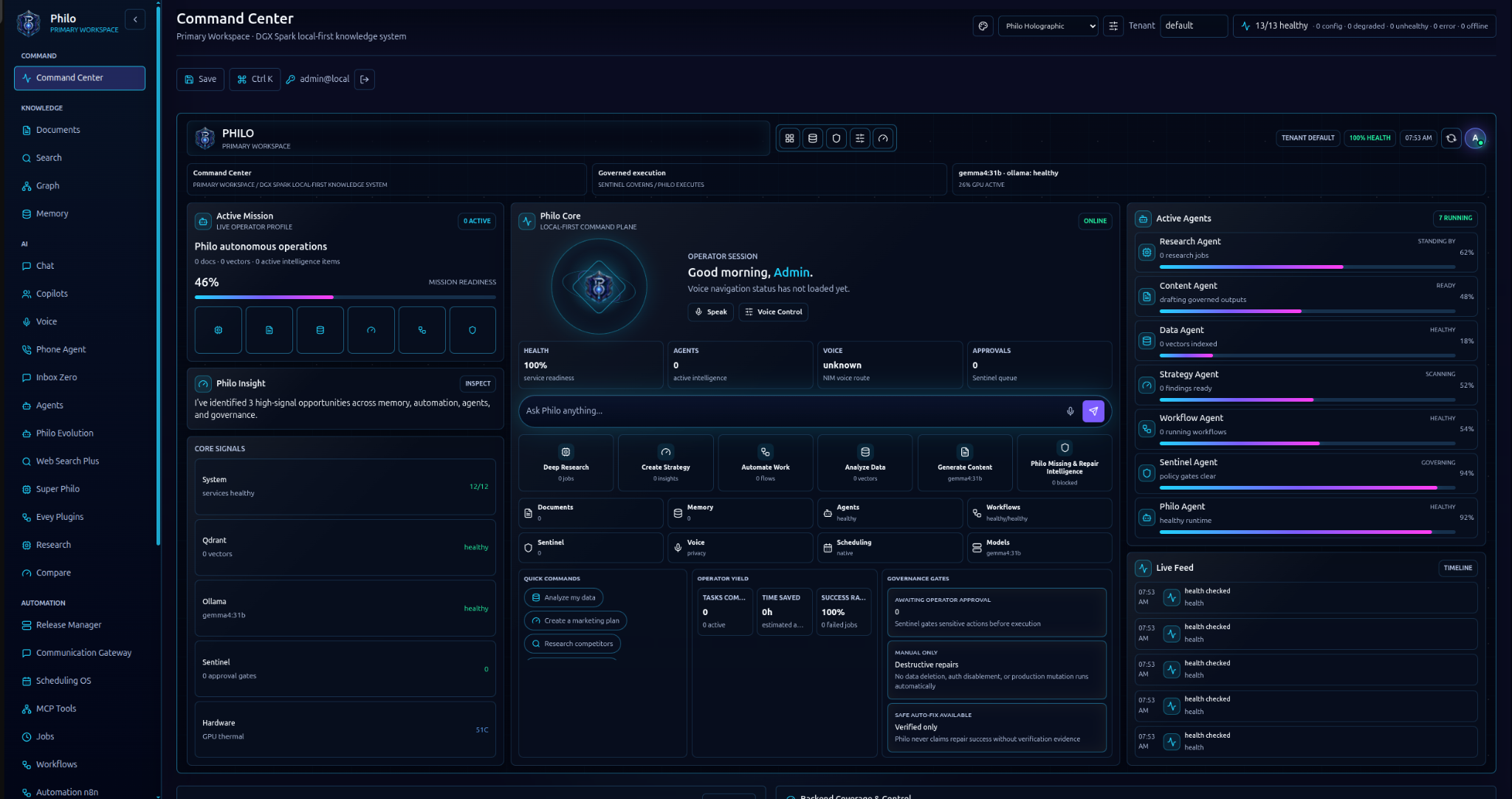
System overview
Mission readiness, local services, agent activity, workflows, approvals, and live system signals are presented within one operational view.
Interface and status values shown reflect the captured workspace session.
One operating environment
Philo brings the surfaces people use to understand, create, coordinate, approve, and verify work into a unified local-first workspace.
Documents, search, graph, and persistent memory create a connected foundation for private organizational context.
Copilots and specialized research, content, data, strategy, workflow, Sentinel, and Philo agents remain visible in one roster.
Session mode, model choice, context, RAG, reasoning depth, and inspector controls remain available at the point of work.
Scheduling, jobs, MCP tools, n8n automation, and release management connect intelligence to governed operational routines.
Approval gates, manual-only boundaries, repair planning, verification, and audit actions keep authority explicit.
Health, queues, event streams, diagnostics, runtime status, and evidence exports make system condition inspectable.
Continuity note: Philo is the new name for the Gozer program. The architecture and mission continue under the Philosophi brand.
System architecture
A modular architecture separates governance, orchestration, execution, automation, memory and model intelligence.
Operating modes
Sensitive actions always respect explicit approvals and policy.
Philo reasons and recommends. You execute.
Philo prepares actions and pauses for approval.
Approved routines execute inside clear bounds.
Multiple agents coordinate toward defined outcomes.
Philo editions
Private intelligence for focus, memory, coordination and daily decision support.
A bounded command center for a team, function or operational domain.
Multi-agent intelligence spanning functions, knowledge and operations.
Mission-scale architecture for complex, high-consequence environments.
Begin with the question